After visiting the
Carpet Museum, we were driven to the
National Museum of Iran (
Muze ye Melli ye Irān) which in fact consists of two separate museums viz. the
Museum of Archaeological Iran ("
Muze ye Irān e Bāstān"), a
Sasanian revival brick building inaugurated in
1937), and the
Museum of the Islamic Era (
"Muze ye Dowrān e Eslāmi", inaugurated in
1972). But in fact we only had sufficient time to see the former but not the latter. The building housing the
Museum of Archaeological Iran has three halls exhibiting various artifacts and fossils from the lower, middle, and upper
Paleolithic ("
Lower/Early Stone Age"
26,000 to 10,200 BCE ), the
Neolithic (
"New Stone Age" 10,200 to 8,800 BCE) ,
Chalcolithic (
"Copper Age" 7000-5000 BCE),
early Bronze Age (
5,000-3300 BCE) [roughly equivalent to the
Hemudu culture (河姆渡文化) (
5000-4500 BCE) ] and
late Bronze Age (
3,300 to 1,300 BCE), and
Iron
Ages I (1,300 to 1,000 BCE ) (the
Persian late
Bronze Age and
Iron Age I roughly straddle the
Shang Dynasty(商朝) in
China from
2194-1046 BCE) I
ron Age II (1,000 to 600 BCE)( roughly equivalent to the period of
Spring and Autumn 春秋 (771-746 BCE), Iron Age III ( 600 BCE to 500 CE ) through the
Median (678 to 549 BCE), Achaemenid (550 to 330 BCE), Seleucid (312 to 63 BCE) [ Iron Age II,
Iron Age III , the Median, Archaemenid and early
Seleucid dynasties are roughly equivalent to the period of
Warring Nations 戰國 in
China (475-221 BCE) ], Parthian (
247 BCE -224 CE) and
Sassanid (224-651 CE) periods. The oldest artifacts in the museum are from
Kashafrud, Darband and
Ganj
Par, sites that date back to the
Lower Paleolithic (
300,000 to 2,500,000 BCE) period. There are also
Mousterian
(
300,000 years ago) stone tools made by
Neanderthals. The most important
Upper Paleolithic (
50,000-10,000 years ago) tools are those from the
Yafteh Cave,
dating back approximately
30,000-35,000 years. There are also 9,000
year-old human and animal figurines from
Sarab Hill in
Kermanshah
Province.
The second building housing the
Museum of the Islamic Era also has three floors and exhibits various pieces
of pottery, textiles, texts, artworks, astrolabes, and adobe
calligraphy from
Iran's post-Islamic era .
We were told that the
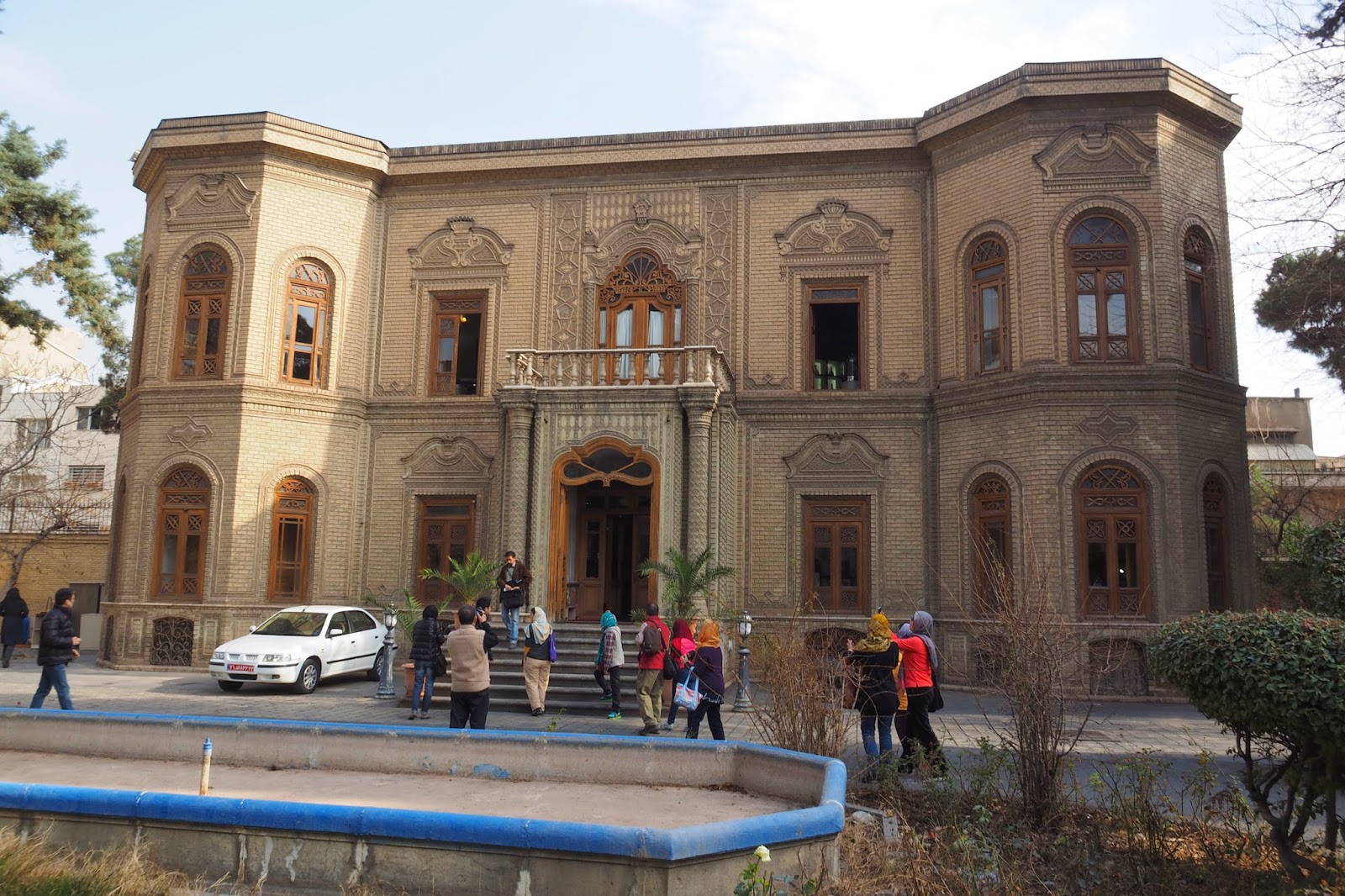
Museum of Archaeological Iran was designed by the French architect
Andre Godard using the kind of brick laying style peculiar to
Persian architecture
.
and its main entrance adopts the style of Sassanid vaults, particularly the iwan of Ctesiphon, the imperial capital of the Parthian or Arsacid (247 BC – 224 CE) Empire and Sassanid Empire(224-651 CE ), the largest city in the world from 570 CE, until its fall in 637 CE during the Muslim conquests.
A full frontal view of the main entrance with its beautiful curves and arches punctuated by straight lines in the typical brownish yellow color of Persian bricks broken by some Persian calligraphic script written in gold over a band of green mosaic tiles.