總網頁瀏覽量

2012年12月4日 星期二

Camellias (山茶花)

It's a really wonderful experience to walk upon a mountain full of camellias after the rain. As far as the eyes can see, there are white camellias, camellias and camellias dotting the dewy deep green of the hillside, sparkling like so many little stars.


I like the drops of rain upon their petals,


or embroidering their edges.


I like the bean like tips of their stamina


like so many heads of the bean sprout.


I like the way they stick so close together and yet not getting into each others' way.


They stick their heads out in so many different directions,


Some upwards,


Others sideways.


And their sepals like to form themselves into a different kind of flower,  with its own shape and color.


They usually grow all by themselves but there can be exceptions too, like these two who seem quite happy to huddle together for company.

Many poems have been written about them. I set out below one by a Sung dynasty poet I like, Su Shi, together with my own translation.


山茶

游蜂掠盡粉絲黃
 落蕊猶收蜜露香
待得春風幾枝在
年來殺菽有飛霜

蘇軾


Camellias
Roving bees robbing pollen of its silky yellow                          
Falling stamen still gathering from
honey dew its bouquet            
How many branches can await the breezes of spring               There’s always flying frost killing
its seeds through the years


 Su Shi  (tr. El Zorro)


2012年12月3日 星期一

A Monkey on My Shoulder ( A coeur ouvert)(開心見誠)


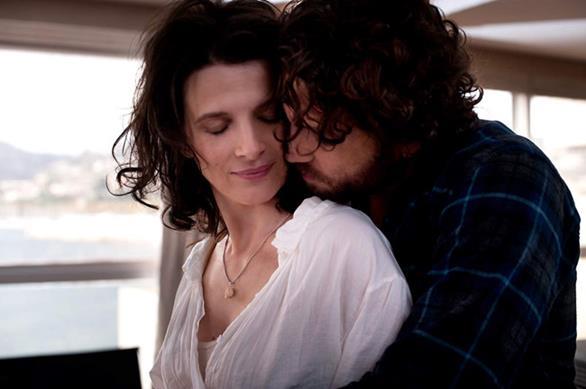
My fourth film at the FFF is another modern day French fairy tale about love.The French title "A coeur ouvert" of the film "A Monkey on my shoulder", literally meaning "To the open heart", is a double entendre. It may refer to the career of a lovebird husband and wife heart surgeon team Javier (Edgar Ramirez) (winner of the Best Male Newcomer César 2011 for Carlos) and Mila (Juliette Binoche) (Best Actress at Cannes in 2010 for Certified Copy ) or to what is going on inside their hearts. It's a film co-written by director Marion Laine with Anne le Ny about the what a pregnancy may do to their relationship.

Mila is modern day surgeon by day and an excitement loving woman hungry for all the sensual fun that contemporary urban life has to offer. The minute they're off work, she would don her helmet and leather jacket, kick start her motorbike and take her husband Javier, a brilliant surgeon who set up the original heart-transplant unit of their hospital, to a bar or night club to drink and dance and then return home to make passionate love with perfect abandon. At the time that film opens, they are already married 10 years and she is still madly in love with Javier. Then in the middle of an operation which started without Javier because he was late, Javier felt that he was unnecessary because her wife appeared to be able do everything without his "assistance" and abruptly left. His wife had to call for urgent extra assistance. Shortly thereafter, Javier received notice that he would no longer be the head of the heart transplant team and he was asked to take up teaching instead. There had been lots of complaints from his colleagues about his ability to be punctual and to have a steady hand at operation because of his alcohol problem. He would have none of it. To add to his problem, his wife was found to be pregnant. Mila told him that she wanted an abortion because she did not want a baby to disrupt their carnal pleasures. But he said he wanted the child which he intended should be born somewhere in Spanish speaking South America, he himself being of Spanish origin. Mila agreed. He was surprised. She said for him, she was prepared to give up everything. He continued to drink and when drunk got into a quarrel with Mila as a result of which he caused Mila to fall. She was rushed to hospital. Fortunately, the baby was safe but Mila was told that she could not leave the country in her condition for another 5 months. So she told Javier, who wanted to leave the country immediately and had already bought the tickets. Upon hearing that, he tore up the plane tickets. When he learned that the new head of the heart transplant unit was his wife, he was stark raving mad that Mila should not have told him anything about it and accused her of conspiring with the others to keep him in the dark about the intended change of personnel. Mila told him that he must get to grips with the source of his problem, his alcoholism but he would not.

In the meantime, he resigned from his post despite the entreaties by the head of the hospital to stay and continue to work in some other capacity. He was taken back after Mila spoke to the head of the hospital Mannon but continued to fail to show up at the appointed time for surgery following which he discovered to his anger, that he was being assigned to do less and less important surgeries. Upon seeing his name on the roster board showing that he had been assigned to do a very minor surgery, he could take it no more and stormed out of the hospital, went on another alcoholic binge and then to his favourite haunt, the zoo, to watch the chimpansees.  After he returned, Mila told him that he must make a real effort to kick off the habit. “We eat too much, drink too much, screw too much and don’t get enough exercise,” said Mila. He would have none of it and the situation got from bad to worse and household objects started flying around during quarrels. But Mila would not give up until one day, when she returned home, she found that some of the walls including that separating the sitting room from the toilet was in shambles and that Javier was right in the process of knocking down other parts of the partition wall of the house with a sledge hammer! He complained in his alcoholic daze that  since her pregnancy, all he heard her talking about was the baby and in addition, accused his wife of having an affair with another surgeon at the hospital. Upon hearing that, she said that she could not take it any more and in her anger, said she did not care any more and that he could choose to go the way his father and his mother did, destroyed by alcoholism. In his rage, he grabbed her. She struggled free and threw him off. Javier left, slamming the door behind him. After a while, Mila felt worried and went out in the night to all the places she thought he might be, bars, restaurants etc,looking for him. Finally, she arrived at the zoo whom she knew her husband would love to go. She was right. He was there but unbeknownst to her, was inside the cage of the chimpanzees, sleeping on the floor out of exhaustion. She too collapsed from exhaustion because of all the walking and anxious rushing about and sustained a head injury during the fall .She reminisced in her coma the good times she had with him in the lake boating in midnight after sneaking in after closing hours some time ago,  Someone found her. She was rushed to hospital again. They did a caesarian. They saved the baby girl at 5.5 pounds. During her coma, she dreamt of the other happy times they had .She dreamt that she was alone in a boat, drifting down a rapids and then fell off the edge of a giant waterfall, plunging hundreds of feet down and then whilst sitting calmly on a meadow and then on another boat how she could see how in the distance Javier was holding their darling daughter above his head under the colorful rainbow formed by the sprays of the waterfall of the Orinoco River in Venuzuela where they were supposed to go after 5 months. Some one found Javier and informed him of his wife's condition. He entered the room where she was recovering on a bed after the surgery, tied his belt around the door knob to prevent people from getting in, went to her bed, and then held and whispered into her ears, how much he loved her and put his legs between hers. Then we hear Mila's voice off, apparently when she regained consciousness from the coma, telling Javier that she was sure that sooner or later he would  come back and hold her again and suddenly, realzing that the weight was off her abdomen, asking where her baby was.  The film ends. 

It's a simple melodramatic tale about how alcoholism, combined with injury to a man's ego from loss of status and jealousy could destroy a marathon adolescent- like love relationship and how in the end, love is stronger than anything else and may yet save a relationship tested to its limits, based on the novel l’Orénoque by Matthias Enard. Juliette Binoche put in a credible performance as a love-crazed wife. So did Ramiriez as the lustful, spontaneous, playful and ape like surgeon  ruined by a fatal weakness: alcohol. The music by Bruno Coulais, who also did the music for The Field of Enchantment in my earlier blog, was excellent as usual but I'm afraid to say, not as good as in the earlier film.  A modern day French melodrama with some moving moments.


2012年12月2日 星期日

A Magnificent German Requiem

Saturdays are usually relaxing but not this Saturday. I had to rush off to the Cultural Centre almost immediately after a meal which I had following an earlier stunningly beautiful French film. But when the concert ended, I felt that all the double quick leg work was worth my while: what the earlier French film was visually, Brahm's German Requiem was sonically. They do have something in common though; both were hymns, but in vastly different ways: the first to Nature and the second to man's divine nature.

In many ways, the German Requiem was a landmark. It established Brahm as a composer not to be passed over lightly. Its second movement was Brahm's tribute to his mentor Schumann who tried to commit suicide by jumping into Rhine two years earlier in 1854. Schumann is not only Brahm's mentor, but also his beloved friend and he had a complicated relation with Clara Schumann, his wife. The piece was a completely new kind of Requieum. It did not have the usual theme of resurrection through Jesus Christ. It was sad in places but there is in that music a certain optimism, a spirit first of quiet, then tender and then of resplendent, almost exploding transcendence, which finally uplifts humanity from the Biblical destiny of a life of sorrow in a vale of tears. As Brahms said, it was written less in memory of the dead than in exhortation of the living. 

Throughout his life, Brahm never had much confidence in himself. For that reason, he was extremely critical of his own work and often had to write and then rewrite his pieces. The piece was written not just in one go and there were fits and starts spanning a number of years starting in 1865. By the time he wrote it, Brahms had already had some experience in choral writing because he was in charge of a woman's choir in his hometown Hamburg and he had already written motets in German, instead of in Latin, as he did in this masterpiece which he substantially completed in 1867. Some scholars suggest that the piece was inspired by the death of his mother, especially the 5th movement. The final piece was not presented to the German public in full in 1869!. It's a peculiar mix of the traditional Bach-style fugue counter-points and cantata form and his more romantic treatment.

Critics and scholars have noted certain symmetries in the 7 movement piece eg. the first and last movement in F major with parallel texts "blessed" and harmonic progression. . The 1st movement is "Blessed are they that have sorrow", the 2nd "For All Flesh is as Grass", the 3rd "Lord, make me know that I must have an end", the 4th "How lovely are your dwellings, Lord of Sabbath, 5th "You now have sorrow, Thee will I comfort", the 6th "For we have no abiding city, Behold I show you a mystery" and the last "Blessed are the dead, which die in the Lord." , To me, the first movement is slow and sad becoming less so as the movement progresses. The second has a very insistent and heavy rhythm which is not dispelled till the very end. The third is bit sombre but wavering and undecided. The fourth is more tender, relaxed and soothing. The fifth also shifts between sadness and consolation. The sixth is where the music finally burst forth in magnificence following its contemplative start whilst the final movement successfully resolves the tension of sadness and sorrow built up by the previous movements by an explosion of joy and optimism which nostalgically recalls certain themes of the first movement but now repeats it in a mood of quiet repose,contentment and acceptance. Far from being a depressing piece, the German Requiem is in the end full of hope.

Except for the much too loud and domineering sound of the low organ notes in the first movement, the HKPO and the combined Tasmanian and West Australia Symphony Orchestras' Choruses under Jaap van Zweden gave a truly unforgettable music performance. Though I have heard the German Requiem in CD before, it's  a completely different matter to listen to it live. The impact is so much more powerful. It'll probably take me some time to fully assimilate these two unforgettable and emotionally powerful experiences in a single day one following so closely upon the heels of the other. It can be a bit heavy going.


2012年12月1日 星期六

The Field of Enchantment (La Clé des champs) (魔法池塘)


For 81 minutes this afternoon, I was sucked into and got completely immersed in another world. That is the world of red poppies, fluffy will of the wisps, daisies, water lizards, tadpoles, water skaters, snails, frogs, toads, eels, water snakes, carps, spiders, dragon flies, butterflies, swallows, owls  and all kinds of tiny insects and reptiles at an out of the way pond in a marsh a little distance from a small village somewhere in France. It's a world where initially one and then two lonely children would slip away quietly during their summer vacation, looking, smelling, feeling and being fascinated by all that they experience through their own eyes and their own senses, allowing their childlike minds to wander into the world of imagination, a private world all their own, establishing a silent bond, joined by their common entrancement by the wonders of the profusion of life on that tiny pond which no farmers would approach because a sheep once drowned there. In that world, they would exchange tiny but thoughtful gifts, dolls made of a blade of grass, a tiny stick and a poppy and tiny boats of leaves with another leaf stuck to a twig to serve as a sail and carrying a cargo of tiny pebbles made by the little girl and a jeweller's magnifying glass by the boy and where they would walk hand in hand under water amidst water weeds and gape at the wonders of nature. It's an enchanted world in which children and nature have become one. The story ends when we see the girl (Lindsey Hénocque) whom the boy names "Iris", leave the village in a bug like Citroen at the end of the summer vacation. But the memory of that summer is etched forever into and deep  within the psyche of the boy protagonist. (Simon Delagne,) whose name we don't even know. Throughout the film, they never spoke to each other. But what passed between them is beyond words. They merely hold hands, play and exchange looks. That is good enough for them. The film however is narrated by the boy in a voice off.

The film is  entitled "La Clé des champs" (literally "the key/secret of the fields"), in English "The field of enchantment"  written and directed by the directors of the former award winning  Nature film "Microcosmos": Claude Nuridsany and Marie Pérennou, The photography by Laurent Charbonnier, Laurent Desmet , Claude Nuridsany  and Marie Pérennou is first class: clean, clear and poetic all at the same time. And the movement of the insects, fishes etc are perfectly matched by the music written specially for the film by Bruno Coulais. It's the type of film done with the kind of meticulous attention to details and spectacular photography and sound as only the French could do so. Like the two children, the memories of that 81 minutes will probably last me an entire life time. 


Saturday Fun

I don't know how it is for others. As for me, this is a French fortnight. Apart from having to take "frites" as substitute meals from time to time, may be I could take some French jokes or is it jokes on the French. Whatever it may be, here are some that I managed to angle from that treasury of fun, aka the 'net"  or is it "l'internet" or "le reseau"?

1. Q:   How do the French kill themselves?
    A:    They shoot 15 centimeters above their heads, right in their superiority complex

2. Q: What do you call someone who speaks 3 languages?
    A: Trilingual
    Q: And what do you call someone who speaks 2 languages?
    A:  Bilingual
    Q: And what do you call someone who speaks 1 language?
    A:  French

3. After God created France, he thought it was the most beautiful country in the world.
    People were going to get jealous, so, to make things fair, he decided to create the French.

4. Seen in a Paris hotel elevator: Please leave your values at the front desk.
    Outside a Paris dress shop: Dresses for street walking.
    In a Chambres d'Hôtes in Brittany, France: "The genuine antics in your room come from our family castle. Long life to it." And.... "Please avoid coca watering, cream cleaning, wet towels wrapping, and ironing drying."

5. A real headache from the famous French Prime Minister, Charles de Gaulle
    "How can anyone govern a nation that has 240 different kinds of cheese?

If you fancy some cheese over the weekend, there's little to beat the French!