總網頁瀏覽量

2012年12月8日 星期六

The Dandelions (Du Vent dans mes mollets) (兩腳生風)

Du vent dans mes mollets       

    
              Rachel drawing a picture of Madame Trebla at her office


Valerie and Rachel watching their teachers making love

Click for the next picture

From left: grannny, Colette & Michel and Rachel at home


Valérie  and Rachel playacting


Valérie  and Rachel

Click for the next picture


The two copines blowing dandelion feathers

After two rather heavy films, it's certainly a most welcoming experience to see the Carine Tardieu's comedy "The Dandelions (Du vent dans mes mollets), adapted for the screen by Raphaële Moussafi from a memoire and starring Agnès Jaoui as Colette Gladstein, the wife of Tunisien-Jew Michel Gladstein(Denis Podalydès ) now living in a small town in 1980's France with her heavily made up but sickly looking mother Judith Magre who moved in with the Gladstein  from a retirement home ostensibly because of an illness which may strike her down any time and who now shares her room with 8 year old Rachel (Juliette Gombert)

It's a really funny film about how 9-year-old Rcahel, the only child in the family found it suffocating to live in a house with her over-protective mother, a silent but hawkish grandmother and a careless and carefree and almost absent father and was dying of boredom and who dreamt that it might be better to be an orphan. As the film opens, we see Rachel struggling on a typewriter to write a letter to Madame Trebla (Isabella Rossellini ), her child psychiatrist, who told her that she could write to her whenever she feels a bout of grand unhappiness. We are then shown how she went to school late because her mother would insist on waiting for the traffic lights to turn green on a traffic free road and then had to beg for the school gate to be opened from a voice on a speaker phone at the school entrance, how she had no place to sit in the class by Madame Danielle (Elsa Lepoivre)  but was offered a seat beside one Valérie (Anna Lemarchand)    ...      a rather talkative and free girl who struck up an instant friendship with her and led her to see the rendezvous of Madame Danielle with the school's sports teacher Monsieur Fadiga (Jean-Baptiste Tiemele) at the toilet of the staff room, hiding behind two sides its door, lying on the ground with just sufficient of their little heads sticking out to observe the feet of and the heads the two lovers and to hear what they were saying to each other and then hiding under a table when they came out to chit chat.

Soon it was Rachel 9th birthday and her mother fussed about giving her a birthday party but no one came except Valérie and her mom Catherine (Isabelle Carré)  because everybody in her class went to the birthday party of another girl in the same class and her family had to eat the leftovers for the next few days. Catherine asked Rachel to show her her room. She was glad to be free from the boredom of adult conversation and the two of them had a marvellous time jumping up and down Rachel's granny's bed and exchanging girlie jokes. Catherine was precocious and soon the two were making up shows with puppets talking adult love talk which they only half understand. Rachel developed a crush for Catherine's brother and imagine getting married to him whilst Catherine developed a similar crush for Rachel's dad. After getting to know Valéry's mom, Michel, himself a plumber, started to go to her house under the pretext of picking up Rachel during her visits and would stay there to chat with the hippie type Catherine until very late to escape from the over-attention of his increasingly fatty wife even began to fix up first her light bulb and then her kitchen. It looked as if they were developing a more than a pure friendly relationship but he never really crossed the boundary.

Saturday Fun

Relationships can be a real source of joy. Not only that, it often comes with some free add ons. Hence they can be the source of endless fun.

1. FOOLING AROUND

A middle-aged couple that had two stunningly beautiful teen-aged daughters but no son, decided to try one last time for that son they always wanted. After months of trying, the wife became pregnant and sure enough, nine months later delivered a healthy baby boy.
The joyful father rushed to the nursery to see his new son.
He took one look and was horrified to see the ugliest child he had ever seen.
He went to his wife and said that there was no way that he could be the father of that child. "Look at the two beautiful daughters I fathered."
Then he gave her a stern look and asked, "Have you been fooling around behind my back?"
The wife smiled sweetly and said, "Not this time."

2.  DARK SECRETS

A boy was told by a classmate that most adults have at least one dark secret and that this makes it so easy to get some needed cash simply by giving their parents a knowing look, saying "I know all about it" and then smiling.
The boy goes home, give his mother a knowing look and says, "I know all about it" and smiles.
His  mother quickly hands him a $50 note and says, "Just don't tell your father. "
Quite pleased, the boy waits for his father to get home from work, and greets him with, "I know the whole truth" with a knowing look and a smile. He got another $50 and a whisper not to tell his mom.
Very pleased, the boy is on his way to school the next day, when he sees the mailman at his front door.
The boy greets him by giving him a knowing look and saying, "I know the whole truth" and smiles.
The mailman drops the mail, opens his arms, and says, "Then come give your FATHER a big hug."

3. A CHRISTMAS WISH

 An elderly couple was celebrating Christmas at home when a fairy appeared.
The fairy told them that since it was Christmas, she would grant them a wish each.
The wife said, "I’ve lived for so many years, but I've never seen the beautiful Swiss Alps. I wish we could travel there."
The fairy waved her wand and SWOOSH! She had a pair of return tickets to Switzerland in her hand.
Surprised at what he saw, the husband became excited and started racking his brain for a wish.
He ruminated for a moment, and then said, "I am envious of those guys who have young wives. If possible, I want to be married to a woman who is 20 years younger than me."
The fairy waved her wand and SWOOSH!
He became 20 years older.

4. THE TRUTH

Johnny had been slipping in and out of a coma for several months yet Jenny stayed by his bedside every single day.
When he came to, he motioned for her to come nearer.
As she sat by him, he said, "You know what? You have been with me all through the bad times. When I got fired, you were there to support me. When my business failed, you were there. When I got shot, you were by my side. When we lost the house, you gave me support. When my health started to get worse, you were still by my side. When I think about it now. ....I think you bring me bad luck!"

5. MARRIAGE 

    Marriage is a relationship in which one person is always right and the other is a husband.

    Marriages are made in heaven. But so also are thunder and lightning.  

    Marriage is when a man and woman become as one; the trouble starts when they try to decide which one.

    It doesn't matter how often a married man changes his job, he still ends up with the same boss.

    Married life can be very frustrating.
    In the first year of marriage, the man speaks and the woman listens.
    In the second year, the woman speaks and the man listens.
    In the third year, they both speak and the neighbors listen.

    When a man opens the door of his car for his wife, you can be sure of one thing: either the car is new or his wife.

6. LOTTERY

    A woman rushed home from work and exclaimed to her husband, "Pack your bags, I've won the lottery!"
    The husband excitedly asks, "Should I pack clothes for cold or warm weather?"
    She says, "Pack'em all, you're leaving!"

7. A WISHING WELL

 A couple came upon a wishing well.
The wife leaned over, made a wish and threw in a penny.
The husband decided to make a wish too but he leaned over too much, fell into the well and drowned.
The wife was stunned for a moment but then smiled, "It really works!"

   
8. ONLY ONE WIFE

   Every man wants a wife who is beautiful, understanding, economical, and a good cook.
   But the law allows only one wife.

   
9. A FINISHED MAN

   A man is incomplete until he is married. After that, he is finished.

10.     SOUND MARITAL ADVICE

          If you want your wife to listen and pay strict attention to every word you say, talk in your sleep.

Have a wonderful and relaxing weekend.


2012年12月7日 星期五

A Few Hours of Spring (Quelques heures de printemps) (春暖心間)

My second film for the evening is as depressing as the first. It's Quelques heures de printemps ( A few hours of spring), a 2012 production by Stéphane Brizé. It's a very understated film, its story told calmly, objectively, and sensitively through some very studied images, accompanied by some quiet music.

It's a story about a former truck driver Alain Évrard (Vincent Lindon) who just got out from 18 months jail looking for work and a little understanding from her 70-odd year old mother  Yvette Évrard ( Hélène Vincent) afflicted with cancer which has metastasised . Mother and son shared the same house but rarely talked to each other. Yvette is the type who wants everything to be ship shaped and spends her days cleaning the floor, wiping the table, ironing her clothes and even towels and who spends her leisure working on a 2000 piece puzzle and wants everything to be meticulously planned. She does not have any friends to visit her nor does she ever go out to have a meal outside or visit any of her friends or relative. The only time she speaks to her son is to remind him to keep the feet of Alain's dog clean after he takes him out on a walk. They eat their breakfast and dinner separately. If she says anything to her non-communicative son, it's to remind him  to seriously look for work. On account of his criminal conviction, Alain could not get any decent job. He did however work for a short while as a garbage picker at an eco-garbage processing plant picking out plastic bottles from an assembly line. There he got to know a friend and went bowling with him and there picked up a girl Clémence (Emanuelle Seigner) with whom he struck up a relationship. But he quit the job after the girl asked him out of interest what he did for a living. He hesitated and then lied and told her that he was a trucker but when she followed up on the first answer to asked him where he went etc, he got mad. He never saw her again.

Life was not easy for Alain. When after a while, his mom told him that he should look for work with more enthusiasm, he flew into a rage and yelled at her and left the house and stayed at one of her mother's friendly neighbors, who learned of the quarrel between the mother and son and paid his mother a visit and suggested that they should at least talk to each other again. Following his visit, his mother fed Alain's dog with rat poison. When Alain got the news, he immediately rushed home and the two of them took care of the dog and then to a vet and became reconciled . Thereafter, he accompanied his mother to see the doctor and do a brain scan. When Yvette learned from the doctor that her condition was getting worse, she did not want to allow the disease to kill her and decided to opt for euthanasia to be concluded in an institution in Switzerland. We are shown Alain attending an interview by the Swiss organization with his mom and then driving her mother to the institution in Switzerland helping people to end their life on a voluntary basis. We see how they were received by the institution, the kind of instructions she received and how she carried out the plan the way she managed her own life, always calmly and resolutely, without any sign of emotion. But when Yvette was comfortably tugged into a bed in a small and tidily kept room looking out on to the surrounding woods in the mountain and waiting for the fatal drink to take effect, she could contain her emotions no longer. Suddenly she pulled his son towards her and put her head on his shoulders and told him how forcefully she loved him. His son allowed her to hold him and told her that she loved her too. The film ends: mother and son are finally reconciled at the hour of death. Is that the meaning of the title of the film?

It's a simple film, done simply, almost clinically, without any fuss, without any judgment, without any exaggerated melodrama. The tone of the film is as serene as its photography and its music Everything is done through images with very little conversation. Hence the tension as mother and son observed each other in complete silence. The cinematography appears to have been meticulously planned.  What rivets the audience's attention in this film is the acting by the two seasoned protagonists. They made the uncommunicative mother and tempestuous and obstinate son pair look credible. Although the story ended in the death of Yvette, it did not end in despair. It ended in quiet dignity. We must imagine her happy. We can hardly fail to be moved. 


2012年12月6日 星期四

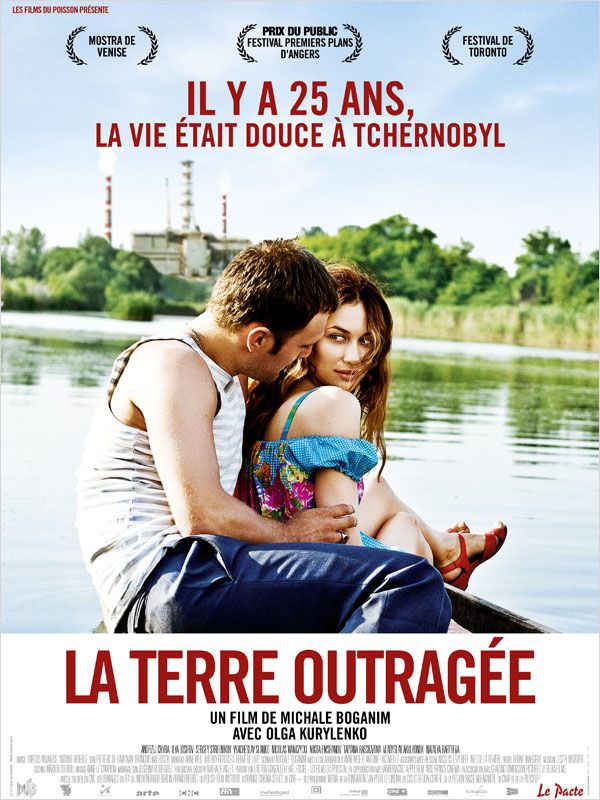
Land of Oblivion (La Terre Outragée)(湮沒之地)


Everyone has heard of Chernobyl, the way they have heard of Hiroshima. Whilst the latter is a name associated with the atom bomb which put an abrupt end to tiny Japan's imperrialist war in fulfilment of its dream of becoming the shining light of Asia, as the highest realization of its ancient samurai spirit, the former is about the horrors of careless use of nuclear energy in peacetime, supposed to be another shining example of the superiority of the  Soviet socialism in action. Did anybody pay any attention to what Chernobyl really means to the lives of its former inhabitants?

The often ignored "human cost" of technological progress is explored by Michale Boganim's first feature film "Land of Oblivion (La Terre Outragée) which traces the lives of three of the inhabitants of a little model Socialist town Pripiat, within three miles of Chernobyl where the catastrophic nuclear leak on April 29, 1986,  about a quarter of a century ago, first had the name of this hitherto unknown town brought to our attention in newspaper headlines across the world: a farmer, a boy who planted an apple tree on a wood  close to his home in the same area as the nuclear plant and a tourist guide. 

As the film opens, we see a beautiful girl Anya (Olga Kurylenko), looking up at the clear blue sky on a summer day comfortably lying on the lap of her young lover Piotr (Nikita Emshanov), on a rowing boat flowing gently down a river.  In the background is the silhouette of the notorious nuclear plant. Off screen, we hear the sound the girl, speaking in French about her story. Next we see a group of villagers fishing on the same river and chit chatting about the coming arrival of elcctricity from several power plants now being built.

Then we see a group of villagers, all dressed up, taking a wedding photo under the statue of Lenin at the town square. From a loudspeaker under the statue, we hear an announcement that there will be a festival to celebrate Labour Day on lst May, when  there will be a fun fair, music and dance and food aplenty and a poetry competition which will be attended by the second party secretary of the Soviet Communist Party . But then, suddenly there was a shower and everybody scrambled for cover. The rain soon stopped and the wedding festivities continued nearby under a tent in the open air. The people drank, sang and danced to the tune of an accordion. In the background, we see a number of fishes with their bellies up on the surface of the river. The wedding crowd did not pay any attention. Then, there was another shower and the people had to seek cover again in a nearby house. Inside a hut, we find the lovers kissing.  We hear a phone ring and the bridegroom, who is a fireman, had been summoned to go fight a fire. The bride begged him to stay. He said if he did, he would lose his job. Reluctantly she had to let him go. Her mother consoled the bride that on her own wedding day, her father went drinking with his buddies and whispered into her ears that  when he returned they had a wonderful time. The bride is Anya and the bridegroom Piotr. Piotr never returned.

Shortly thereafter, we see a military helicopter landing on a field with soldiers in protective plastic clothes spraying petrol on the farm houses there and burning them whilst other soldiers ordered the people to leave immediately  and not to take anything with them. They did not give any reason. Some suspected that it was war with America. Some of the farmers put up some resistance but in the end, all had to go into a coach. Anya and her family had to go too. We learn later that they are now living in a nearby town some 30 miles away.

Then the scene cuts to an engineer Alexei at his own house taking out a radiation dosimeter(which measures ionizing radiation) he has on his waist to measure the radioactivity outside his house. After receiving a telephone call from his senior, he told him that they must make a public announcement on the radio and TV, an idea which did not receive any favor. After that he begged and then ordered his wife and child to leave the house immediately and drive their family car to the house of their relative in the next town and in the meantime, he himself went to the local market to warn housewives and others there not to buy the meat which he found had been contaminated by radiation but the townsfolk, who did not know what was going on, treated him as if he were a fool and a mad man because on account of his position as a state official, he was bound by an oath of secrecy not to reveal the true cause of his warning. When he reached the exit of the market, it was starting to rain. He asked the middle aged lady selling foldable umbrellas hung against the wall there how much they cost. The woman replied 30 roubles each. He took all of them without a thought and then went out and gave them to whoever he saw in the streets to protect them from the radioactive rain. The enormity of his burden upon his conscience eventually proved too much and ironically, he actually went mad. Amongst the people he helped was Anya who was sleeping on a roadside bench a little distance from a hospital. She had just come out of the hospital from which she learned that her husband had been found with radioactivity level exceeding 1600 degrees and had been sent to Moscow. The nurse there at first refused to tell her but upon being told that the man she was looking for was her husband who left to answer a call to fight a fire on her wedding day, she relented in breach of the secrecy regulations.

This French-German and Polish co-production is done in quasi documentary form. We see Anya, a decade after the leak introducing the the town. now called "the Zone" , to French tourists in radioactive-proof gowns in a tourist bus, still unable to forget what happened that day. She was now in love with another former colleague of her husband and who had actually set about putting into practice his promise to build a new home in that town but she refused to marry him and although she had now also got a French boyfriend working on a local project who promised to take her to France and she agreed, yet at the last minute, she didn't go. Somehow, something inside her would make her return to Pripiat again and again although there is not much there except ruined buildings overgrown with weeds, abandoned factories and museums and devastated landscape. We also see how Valery, the son of of the engineer Alexei would despite her mother's express orders and despite the relevant Government safety bans, go back to the house of his childhood, spend time there, looking at old photographs, wearing clothes hung in the closet, and touching various objects in that house, playing a few notes on the abandoned piano and looking for that apple tree which he planted with his father, whom his family had taken to be dead, some 10 years ago. In the meantime, we see that engineer had become a "lunatic", always asking people in the railway stations what their names were, where they came from and putting everything into a notebook because somehow, he thought that important . He was always hitching rides on the trains passing through  Propiat which had long ceased to stop there.  We see also one of the farmers who stubbornly refused to leave his farm all through the years and is now growing apples for sale to tourists which the bride would still bring from time to time. The bride's own house nearby is now occupied by some immigrant squatters from other parts of Ukraine and when she went there she was told to get off at gunpoint.

It's a very strange film, made like a documentary and filmed on location and yet is not. There is a certain sensitivity to the feelings of what it portrays in well composed images often at long or medium shots. There is huge contrast in the images of the town "before" and "after": lyrical and full of life "before", cold, deserted and eerily desolate "after" and yet it still held a certain inexplicable fascination for some of the people who for one reason or another are still living there, including a little girl who would flit through the ruins and rubble singing children songs as if the place were a giant playground; the engineer's son Valery who returned to the place during the 10th anniversary commemorating the deaths of the villagers, brought there by his mother and their neighbors, the bride Anya who had not yet consummated her marriage and who was in a sense still looking forward to bringing a closure to that non-completed relationship, feeling an irresistible urge to return to the place again and again, albeit in the capacity of a tourist guide looking after French tourists and the stubborn farmer who refused to quit his farm. Through the mouth of Anya we learn the history of the place. As a local, there is an added authenticity in what she says which the tourists can feel. So can we. There is a love of the land which no amount official regulations and pragmatic considerations can ever touch. Perhaps there are two Pripiats: the Pripiat of reality and now officially proclaimed a quarantined and protected  radioactive "zone" which people can only enter with official papers and another Pripiat, that still living somewhere deep within the psyche of some of its former inhabitants in another realm of time which is beyond time. It's a film of loss, of stubborn hope and a celebration of the indomitable human will to somehow repossess its own history.


2012年12月5日 星期三

Adieu Berthe-Enterrment de Mémé (Granny's Funeral)


I was plunged into reflection again last night into the world described by the last blog of my friend Peter: the world of death. But it was not through the "usual" route of meditation or philosophy. It's through comedy. I saw my fifth French film  Adieu Berthe-Enterrment de Mémé (Granny's Funeral) by Bruno Podalydès (Dieu seul me voit, Liberté-Oléron, Le Mystère de la chambre jaune) featuring his brother Denis Podalydès (
Embrassez qui vous voudrez,  Da Vinci Code, Laissez-passer,
La Conquête
) Valérie Lemercier (Les Visiteurs, Le Derrière,
RRRrrrr!!!, Bienvenue à bord
), Isabelle Candelier (Dieu
seul me voit, Mercredi folle journée
) and  Catherine Hiegel (La vie est un long fleuve
tranquille, Gazon maudit
). 

As the film opens, we see a woman Alix (Valérie Lemercier) (Alix being a dentist separated from her own husband whom Armand Lebrecq (Denis Podalydès). the protagonist, met
at a dental appointment whose first "love photo" with Armand is an
X-ray of his teeth) besides a blue box with a red sliding door with floral patterns on it stuck with various daggers. Beneath the lower edge of the box, we see the figure of a man in a white shirt: Armand. They're rehearsing for a magic show for Alix's 8-year-old daughter's birthday the following Wednesday. In the middle of the rehearsal, a cell phone rang. It was passed to him. He spoke, He had to explain that he sounded weird on the phone because he was in a sort of "room". He learned that Berthe is dead. Berthe is his own grand mother living then in a retirement home. After receiving the call, he got his head out of the box and sat down. He began to reminisce that lately, he had not been paying as much attention to his grand mother as he should, saying how independent, how secretive she had been and how she always insisted on good form.Tears welled up in his eyes. But when asked, he said it was nothing and that he was OK. They made love. Then he went back to his place of work, a little pharmacy in Chatou (a small town in France) using a tiny motorised step board on wheels the manoeuvring of which he appeared to have completely mastered.There we find him talking to his wife and partner Hélène Lebrecq  (Isabelle Candelier) who asked how it was. In their conversation, we learn that they were working on their separation but found it was so difficult because they seemed to have gotten used to each other for such a long time. They had to carry on their conversation amidst constant interruption by I-phone SMS text messages of love from and to Alix which Armand had to squeeze in with great difficulties between the constrained space between packets of pills and other medicine inside drawers mounted on sliding metallic shelves of his pharmacy, either to read and to answer  She said that the thought having breakfast every morning without Armand was unthinkable. They felt bad and whilst taking a break to get a breath of fresh air outside of their little pharmacy, we hear Hélène's self-assertive and domineering mother Suzanne (Catherine Hiegel ) living above their pharmacy shouting through the window that she hadn't paid her rent for two months but  thinking that Armand was not around, she told her daughter that she was of the strong opinion that Armand should give his granny a "grand burial" and for that purpose had found the name of a good funeral home. We see Armand making signs of protest and ridicule under the verandah against Hélène's "mother superior". The search for a funeral home had to begin in earnest.

Armand searched on the internet, tried the telephone numbers on some of them and got responses from pre-taped telephone messages with people speaking foreign accented French and when he finally got through to a human person, he stated his requirements and got numerous options in incomprehensible French. Finally he decided to go to an ultra hi-tech looking funeral parlor, the "Definitiv". He wanted to know if a funeral could be arranged for Tuesday or Thursday in order not to clash with the birthday of his girl friend's daughter. Whilst waiting for his turn. He was offered wine and biscuit. He looked surprised. He tasted it. It was good. Opposite him sat an elegant lady in black reading a magazine. They looked at each other politely. They did not say anything to each other. Then she cried. Then we see her pulling out a paper handkerchief from a box (believe it or not) about a foot and a half long to dry her tears with tissues of equal length. Shortly thereafter, he was met by a tall gentlemen in very formal dark suit Charles Rovier-Boubet (Michel Vuillermoz) and shown a variety of coffin in different shapes, colors, sizes all with exotic names and with a running commentary on which political celebrity and entertainment star had chosen which. He said he wanted a small one because his granny was not tall and whilst talking we are shown him in a static shot in which his silhouette fitted perfectly against a white Egyptian mummy type of coffin. He was given a variety of options including one called "The Twilight". The tall gentleman in dark tried to show him a video of it with a laser controlled remote but he had to pass his hand through the laser light above the control many times without success, Armand also tried many times, but with equal result. Finally, the tall gentlemen had to show him what it was on the tiny screen of the "remote control panel", moving his finger across the screen quickly to get a new image and enlarging the image by using his thumbing and index finger like what we do with our own I-phone.But we see only flash of greenish white light upon their faces each time we got a new image was supposed to appear on the tiny remote control monitor screen. He said he had to think about which option to adopt and tell the gentleman later because he had to discuss the matter with others. Before the introduction was completed, we suddenly see Alix appearing behind one of the coffins making signs to him and he replied the same manner, aided only by silent words on his lips. When they finally got the chance to talk, Alix said she thought she should help him.

In the end, Armand decided against using that high-tech funeral service and used a simple family type funeral parlor which he found accidentally in a cemetery close to the high-tech funeral home. He got to talking to one of two  undertakers there then in the process of putting the final touches to a tomb and learned that they are developing a profitable new line of business through the internet catering specially for the coffins and burials for all kinds of pets. He asked if they could find him a spot for Tuesday because the other funeral home could only give him Wednesday. It was OK. So he decided to use them. But in the end, his new undertaker got an accident on the road and the funeral had to take place on Wednesday, ending up with "mother superior" stepping in and using the high-tech funeral service using the expensive and pompous "Twilight" ceremony. In the middle of the funeral speech, interrupted by the irrelevant demands of his own  senile and alcoholic father's demand for more drinks, Armand broke down and was just rambling about how little he knew about her granny, and how life and death, love and secret loves of his granny which he discovered from reading the words of affection exchanged between her and her lover even after her marriage, which she carefully kept in a  a box of letters, postcards and telegrams whilst going through her personal effects after being stranded at the retirement home on account of his chosen undertaker's road mishap. which ironically forced him to have the funeral on Wednesday, after all.The film ends by Armand going to the party of Alix's daughter in which they performed the trick about the disappearing magician which Alix and he were practising at the opening of the film. When Alix lowered the red cloth above the box in which he was locked, expecting Armand to appear beside her, we see that Armand had magically "disappeared" altogether, leaving behind only a blue cloth at the bottom of the box.

The film is not just a caricature of the often commercially motivated exaggerated respect the living pays to the dead but also about the kind of petty incidents of everyday contemporary life which show how genuine love, the force of habit, the tiny hypocrisies which one has to invent for the sake of good form and politeness are mixed with the little joys and sorrows in the often hilarious attempts a man struggles to make to reconcile the complexities of a life caught between his love for two women, his wife and his mistress, who both love him and of a man torn between his pharmacy and his love of magic, between his love for the daughter of his mistress and his own son Vincent who spends all his time in front of the computer screen playing video game and how in the end, everything including life and death are so mixed up that it is difficult to tell who is right, who is wrong where, when, to whom, a bit like the magic which we see at the start of the film, something which we try very hard but clumsily to conjure. What is reality? What is love,? What is folly? What is illusion? What is magic?  What is life? What is death?  Does it matter?   

The acting is good, the dialogues chosen with great sensitivity, the angle of this story done a million times by others, the unusual mix of tenderness and irony excellent, the cinematography and music unremarkable. As the film ends, we see Berthe's ashes being thrown into the air into a river, the way the magical flower used by Alix's daughter in her performance at her birthday party floated gently above the same river. A thoughtful ending to a very French "comedy".  Is the opening scene where we see Armand negotiating  with a certain finesse between the narrow streets of Chatou between his mistress's house and that of his pharmacy with his waiting wife the very image of Armand's life? Is the scene where Armand caught his son flunking his philosophy test without telling him  when he put in a slip shod paper when asked to write on the subject "Qu'est ce que  "vouloir"?" (What is want/desire/ will?) a key to what it is that Bruno Podalydès wishes to explore in this film? Is the scene where he sat on a lovely little field mouse on the garden of his granny's retirement home meant to suggest something about the nature of human life too? To say the least, it's an ambiguous film, not totally burlesque and certainly not slapstick and yet not totally black nor white either. I do not know whether that's deliberate. There is a certain unsteady balance: the film seems poised precariously between sadness and irony, between seriousness and quiet hilarity, between magic and reality. One can't really put one's finger on what Bruno Podalydès really wanted to do. But then, why should there always be a definitive answer, one way or another? Is "Definitv" really the end of Berthe's life or for that matter, the true end of the film?