總網頁瀏覽量

2011年3月22日 星期二

A Feature Film?

The HKIFF has begun for me last night! It began with a bang! I am not so sure I like the bang. It hit me. It dazed me. It puzzled me. It hit me with boredom. It dazed me with stupor. It puzzled me how easy one could pass for an author of a so-called "art film".


As the film "The Ditch"  (2010) opens, we see some people huddling on the ground of some yellow dirt. On screen right, there appears part of what looks like the side of a tent. Two figures approach. Then a third appears in the distance.The last figure was the director of a labour camp. The two newcomers were asked to go into a hole dug into the ground: a ditch, euphemised as "Dormitory No.8".  To the left was a row of  a dozen beds with some yellow dust covered quilts. To the right there was an opening serving probably to let in a bit of light and fresh air. Along one side of the dug-in mud wall we see some worn out looking wooden sideboards with hot water flasks and eating utensils. People moved about in silence, expressionless, with little interaction. We are then shown people sitting on their bed greedily slurping something up from a shallow metal soup bowl. Some workers moved in, approached one of the beds, wrapped something up, tied it with pieces of strings and bundled it out. It was a dead body. Outside, we are shown a row of people shovelling listlessly, without enthusiasm, without strength, at the side of what appeared a long ditch in the vast expanse of the Gobi Desert. Some one fell. Others tried to drag him up. He had no strength even to stand up. He was hauled upon higher ground to give him more air and probably left to die.


This goes on and on and on. We are shown more people dying, people scraping, struggling for every bit of food, eating seeds from what sparse vegetation there may be on the ground, an old man vomitting, another picking up the undigested seeds from the vomit on the ground and putting them into his own. Two of those inside that underground room got letters: their wives were divorcing them whilst in another corner, an  illiterate old man was asking a literate one to help him write a letter home, asking them to send more food supplements. We are shown more scenes of bodies being bundled up and dragged out from the "ditch", every morning and of people knowing that they are going to die and asking their friends to help them deal with their bodies after they go. One young man Lao Dong told another Xiao Li to hide his body at a corner in the hole for several days until his wife Gu arrives from Shanghai and for her to bury him but if Gu does not, then to take him outside and bury him. The wife arrives, discovers him dead, cries in ear piercing shrieks and wants to find his body, but not before she has given away in despair the biscuits she brought for her husband for those in the cell to share, then begs to be brought to where her husband is buried. Nobody knows. She begs again. Then she was told to go see the supervisor. She goes, sees a pettty proletarian official, got a lecture on evil middle class rightist value from that keeper of the death register book because she demanded to know where her husband's body was and swore not to leave until she did so. She returns to the cell and begs for more information. Nobody gives her any. She goes out all alone. She looks around. There were hundreds of earth mounds about. She digs one, two.... She does not find her husband, digs the dirt with her bare hands, covers up the corpses again when she finds a body other than her husband's. Finally with information of her husband's cell mates who initially were reluctant to let her know the horrible truth that later corpses were not buried but simply left piled up along the dust, she finds it. Her husband's mates help her burn it with scraps of twigs and leaves, setting up a bon-fire amidst the wasteland. 


The scenes depicted were those at Jiabiangou, one of the thousands set up during the Anti-Rightist movement following the "Let A Hundred Flower Bloom" movement launched after the spectacularly disastrous "Great Leap Forward" 1958-1961 in which Mao urged the Chinese people to do in one day what the West would take twenty years. In the "Hundred Flower Bloom" movement, later described by Mao as "luring the snakes from their den", Chinese intellectuals were encouraged to voice their opinion on how the Socialist Revolution might go forward. The result was a flood of criticism more than the Chinese Communist Party could swallow.Those who honestly voiced their opinion were accused of having rightist bourgeois thinking , the equivalent of being accused of being a devil or a witch in Medieval Europe, and sent to so-called Labour Camps for "re-education". Jiabiangou was one of them, in the middle of nowhere in the Gobi Desert. Some three thousand political prisoners were arrested and sent to the Jiabiangou Labour-Re-education Camp – which was only built to hold fifty inmates – in the middle of the Gobi Desert, more than 2,500 of whom either were starved to death or if not died of dysentry or simply exhaustion.


Partly inspired by Yang Xianhui’s novel Goodbye , The Ditch is said to recount the harrowing story of life at the labour camp. The co-maker, screenplay writer and director of the film ,Wang Bing devoted several years to interviewing survivors of the camp, who shared their devastating and chilling experiences. Because of unbearable hunger, prisoners were forced to forage for scraps of food: leaves, seeds, rats, even human vomits and feces and human flesh from dead bodies of other inmates, so severe was their hunger. As the film ends, one of the inmates was told to stay behind to help the camps's director  because the authorities knew that it was impossible for the current batch to do any useful work because they were rationed only 8 ounces of fluid food per day and had to be sent home by a train because the daily deaths was more than they could handle.

It was a film with potentially explosive emotional impact. But director Wang Bing chose to use a spare documentary style, without music, without story line, just bare, stark "reality": the reality of hunger, death, despair in that darkest hour of Chinese history. Nothing is made of the stunning immensity of the Gobi Desert or its desolation. There was no plot, no explicit drama, no use of the camera through panning, close-ups or camera movements etc. The camera was static. So were the scenes depicted. There was no music. Nor any contrast between the silence of the dormitory of death and the howling cold winds of the Gobi Desert outside nor that between the spectacular sunrise or sunset of the desert outside and the murkiness of the dormitory of the dying within. Nothing stands out: a landscape of uniform boredom, unrelenting bleakness and unmitigated gloom. I find it particularly unedurable that the director subjected us to the non-stop shrieking of Gu for more than two minutes when she learned of her husband's death. It was positively ennervating and shows an utter lack of artistic sensitivity or restraint. Probably, the director never read LaoTzu. Others may like it. But for me, it's a colossal flop. It is an artless "documentary" which passes itself off as a feature film or more likely its reverse. Perhaps, it was deliberately "artless" so as to enhance the sense of "verisimilitude". I can understand Wong Bing's dedication to unearth for us this now forgotten episode of Chinese history, he having spent three years tracking down and interviewing survivors and wardens of this forsaken corner of the Gobi Desert on what actually went on there but I suppose there are more interesting ways of doing so than merely "reproducing" what obviously is a "staged reality".  As it is, I find it as dry as the sands, as monotonous as the landscape and about as moving as the empty expanse of the vast Gobi Desert skies. But I do like that dramatic scene in which an old CCP party cadre who had served the Revolution since 1938 confronted the camp director. There should have been more scenes like that to create more dramatic conflict and emotional tension! 


        Communist Labor Re-Education Camp officials waiting for new arrivals


    • play

    The new Arrivals entering into their "ditch" 


    • play

    Man scraping for seeds from stunted desert plants to abate his hunger


    • play

    An inmate's wife looking for her husband's make-shift grave


    • play

    Men awaiting other arrivals


    • play

           Co-producer, screenplay writer and director Wang Bing


    • play


2011年3月21日 星期一

Dvorak at the City Hall

Antonin Dvorak (1841-1904) is a Czech who devoted a great part of his life to colllecting of folk melodies of his native Bohemia and is considered by some as the father of its Czech national music. Two weeks ago, we had an all Dvorak program from the visiting Gewandhaus Leipzig Orchestra under Riccardo Chailly. Yesterday afternoon, we had another one at the City Hall but this time under John Harding, the concert master of the HKPO, doubling up as its conductor..


The first part of the programme was Dvorak's Symphony No. 6 in D major Op. 60, premiered in March 1881, about 130 years ago, when he was 37. Apart from his Ninth (the New World), this was one of his greatest. In it, he blended Bohemian folk melodies into a Germanic romantic structure. It is an energetic symphony with the first movement Allegro non tanto , in D major sonata form in which there were two main themes and two secondary themes in B minor and B major, repeated from time to time by different sections of the orchestra and ending in a confident  D major. The second Adagio in Bb major, is a rondo with variations, quite romantic, with its themes played often by the horn and oboe. The third movement is where the Bohemian folk material in D minor and then D major, entered most evidently. It is in the form of a Czech dance: the Furiant, a quick dance in triple time  The finale is again in sonata form in D major ending in a fiery climax. In this symphony, we find elements of both German (especially in the first and fourth movements which some compare with Brahm's No. 2 ) and of Czech influences in the third which Dvorak skilfully weaved together into his uniquely personal idiom. Whatever may be the case, I find the symphony full of hope, optimism and enthusiasm.


The second part of the programme was Dvorak's Piano Quintet in A Op 81. According to the Programme Notes, the piece is rich in instrumental colors, rapid changes of mood and dynamic Bohemian dance rhythms. Both the first and second movements contain folk dance melodies, the second being in the form of dumka whilst the third is based on another traditional Czech folk dance with sudden energetic twists and turns called the Furiant, used also in his Symphony No. 6. The finale in Allegro was certainly lively and happy. The quintet was played by John Harding as violinist with Rachel Cheung on the piano, Wang Liang as second violinist, Andrew Ling on the viola and on the cello, of course Richard Bamping. They showed perfect co-ordination with great sensitivity to each other's play. As usual, the acoustic of the City Hall is perfect for strings. A most enjoyable Sunday afternoon.


/P>


/P>


2011年3月20日 星期日

The Rite

Friday night was frightening. I saw a film. It was called "The Rite", a film on exorcism based upon Matt Baglio's book The Rite: The Making of a Modern Exorcist, directed by Mikael Hafstrom, starring that excellent veteran actor Anthony Hopkins (Father Lucas), Collin O'Donoghue ( Michael Kovak),  Alice Braga (Angelina Vargas) and Marta Gastina (  Rosaria) 


As the film opens, we are shown a child onserving from a distance his father doing make-up for various corpses in readiness for funeral at his funeral parlor. He was told by his father never to inquire into the lives of the corpses. Then we are shown him grown up. He was messing around with his friends in a disco. We found out that he did not like the idea of dressing corpses and preparing their bodies for cremation or burial all his life and had deided to join the priesthood because it offered 4 years of free college education. He took the course but when it was time for him to declare his vows and be ordained as a priest, he hesitated. After he sent in a letter of resignation saying that after some serious reflections he felt that he did not have the necesary faith, something happened which changed the course of his life. He was asked to have a talk with Father Matthew who managed to induce in him a mixture of a sense of guilt and a veiled threat that if he opted out, he would have to repay all his educational expenses, about $100,000. After the talk in the evening, Father Matthew stepped on to the kerb still thinking about something or other, perhaps trying to talk further to Michael, did not see a coming car which hit him and which then had to swerve to knock down another passing middle aged cyclist. She was lying on the floor, blood streaming down her face, saw Michael, and pleaded for him to come to give her her last rites and to absolve her from her sins,  her eyes filled with a sense of relief upon seeing him. He had no choice and did so, despite his initial doubts. 


We are next shown Michael crossing the chaotic traffic of the streets of Rome walking towards some august Roman buildings of the Vatican. He had been selected for a course on exorcism there probably because he had shown himself possessing the kind of qualities thought needed for such an unusual role perhaps because he had shown himself brave enough to face with equanimity physical violence, blood and death. He was however still full of doubts about so-called miracles and the existence of the devil which he voiced at the seminar, such doubts being also shared by another lady member of the class, whom we learn later was a journalist, Angelina, assigned to cover the priests training in exorcism. The teacher of the course, Father Xavier,  also discovered his reservations and after class, asked him to meet one Father Lucas, living in a dilapidated house at the outskirts of Rome, introducing him as a very experienced exorcist who knows everything there is to know about devils and how to drive them out of people. With hesitation, he went there and had his first taste of Father Lucas'  exorcism in real life, having to do with a 16 year old  Italian girl Rosaria, who had been raped by her father and was carrying his baby and was showing signs of demon possession. She was shown speaking English although she never learned it. After Father Lucas's excorcism, she coughed out three 5 inch iron nails from her mouth! Her forearm show the same tattoo as as that on that of the last woman he prepared for funeral. 


In the rest of the film we are shown more and more episodes of demon possession and what had to be done to drive out the relevant demons. It appeared that the demon must be asked to declare himself by name, which they invariably do despite strong resistance against so doing apparently because the name of Jesus Christ would somehow cause them intolerable pain.


Rosaria eventually died in her hospital bed of a miscarriage despite Father Lucas' exorcism. Her death seemed to have crushed Father Lucas, who was staying outside of her hospital room all night long just in case the devil returned. He had done everything he knew and still failed. After this, he began to have doubts about his own abilities to fight the devil although he had been doing that with confidence all his life. He was seen in his room with all the portraits, crosses and busts of or other signs of Jesus and Mary upside down and when approached for blessing by a young girl, simply flung her aside and was walking about in a perpetual daze and sitting in the rain, as if he no longer felt anything, like a living corpse. In one of his his saner moment, he asked Michael to get Father Xavier to exorcise himself. Michael tried to contact Father Xavier but was told that he was out of town for a number of days. He had no choice. Michael was forced to do what he observed Father Lucas himself doing. He took up the Bible and a cross and pressed it against the face of Father Lucas and ordered the demon to declare himself, which the devil did, but not after some display of rage, knowledge and power. It was Baal! What he saw with his own eyes had made it impossible for him not to be convinced of the reality of demon possession. As the film ends, we are shown Michael finally clearing up the debris in the courtyard outside of Father Lucas's house, which he had seen I do know how many times before and restoring some kind of order to it. He is last seen hearing a confession of another woman, but as Father Kovak.


It was a very powerful film. Anthony Hopkins's acting was superb, as always. Collin O'Donoghue was not bad as the converted doubting Thomas.  No review of the film would be complete however without paying tribute to the excellent work by the sound engineer. The photography too was good, with plenty of close ups which adds enormously to the emotional impact of the film. A spine chilling Friday night!


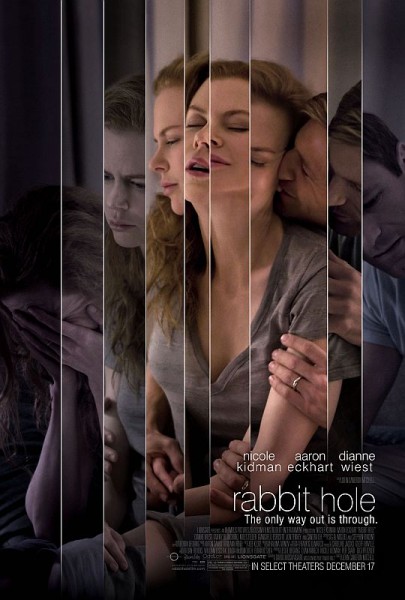
Rabbit Hole

The Saturday sky was gloomy.  I sought solace in something darker than the sky. I immersed myself in the complete darkness of a movie theatre. I found myself in a sunny California suburban home. Nicole Kidman was tending some flowers in her garden. She rejected her neighbor's gingerly last minute invitation just across the garden fence for another one of her neighbor's cook out for her family and friends. She had to attend a support group meeting that evening.


It was a film adapted David Lindsay-Abaire from his own Pulitzer prize winning Broadway play of the same name, directed by John Cameron Mitchell and starring Nicole Kidman as Becca Corbett, Aaron Eckhart as her husband Howie Corbett, Dianne Wiest as her mother Nat and Tammy Blanchard as her sister Izzy.


Them we are shown  that Howie returns home from work to find his wife cooking something before the oven. He approaches her from behind and wishes to be intimate. She says she is not in the mood. The husband goes to a corner to sulk and was watching a black and white video on on a small I-pad. We are next shown the couple attending a support group meeting in which an Latin couple was reminiscing how they missed their lost son after 8 years saying that perhaps God wanted him as an angel and took him. Becca bursts out saying that if God wanted an angel, he could certainly make one. Everybody was surprised. The Corbetts excused themselves and left. Becca never returned but Howie did.


We're next shown Izzy coming to visit Becca. They chit chatted. It was obvious that Izzy was trying to pick up men at bars and later got into trouble in a brawl with another woman and Becca had to bail her out. She is unrepentent and said the other woman deserved her punches and later announced that she was pregnant. Becca brought her some clothes of Danny, the son of 4 she lost 8 months ago, saying that her sister could save several hundred dollars but Izzy said she was not sure if it was a boy. Nat said that it was likely that Izzy might have a girl. Nat left with the clothes she brought and threw them into a garbage dump. Becca sees a child on a supermarket trolley whining for a three dollar chocalate bar at a supermarket and the child's mother resolutely refusing to let him have it. She couldn't control herself and told the mother to make the child happy. To be expected, she was told to mind her own business but when challenged whether she had a child, she could no longer control herself and slapped the woman, stunned into instant silence.


Next we are shown Becca trailing a teenage boy in a school bus, followed him to a public library, and read the book he just returned. It was called Parallel Universe by Alan Guth, a physicist and cosmologist. She tried to go to Sotheby's to meet old acquaintances but was told that all her old colleagues had gone. In the meantime, she continued to track the teenage boy and finally caught him playing truant. They got talking in a nearby park We learned that he was the driver of the car who knocked down her son Danny, whilst the latter was chasing their dog in the street. He admitted that he might have been driving a little too fast. She said she did not want to blame him and that it was just an accident. There were tears in their eyes in the silence.She learned that he was drawing a half finished comic about a parallel universe in which a father might meet his dead son in another universe through a "rabbit hole" in the universe or what some scientists called "worm holes" in the universe through which one may burrow down inside further and further until one emerges into another universe where the outcome of what actullay happened on our earth might be regarded as only one of a number of possible alternative versions, rather like the rabbit holes of C. S Lewis' Alice in Wonderland.  He promised that when it was finished, he would show it to her. 


In the meantime, we are shown that Howie also lost interest in the support group, took back the Danny's dog from Nat's house, was angry at it and then felt sorry that he was. It was obvious that the dog was the only living reminder of the Danny he lost. He began to take pot with another female member whose husband had left her and nearly had an affair with her but pulled back at the last minute when she was waiting for him at the doorsteps of her house. He returned home and found the boy just entering his house which he had finally decided to sell at the insistence of  Becca, who did not wish to be further reminded of her losss. Howie was surprised, angry and suspicious how well it appeared they knew each other. Becca tried to explain that it was not what he thought and explained what the comic story was all about. He finally understood that that was Becca's way of effecting the closure to the grief caused by the loss of their son. When the film ends, we are shown the couple sitting facing the spectators with her hand reaching for his, caressing it with an expression of silent tenderness.


It was a simple film of how different people cope with loss of their son. Howie needed external emotional support. Some people relied on God. Becca wanted to deal with it her own way, with anger, with finding out what caused Danny's death and the personality of the person who killed her son. Her connection with Danny was paradoxically through understanding that killer whom she found to be just a talented high school senior about to enter Connecticut College to do astrophysics. There was a scene in which Nat and Becca was talking to each other as they were putting away the clothes and toys of Danny into the cellar of Becca's house because once prospective buyers saw all those toys of Danny's room and learned that he was dead, they instantly lost all further interest in buying their house. Nat said that when she lost her 29 year old son Arthur, a drug addict, she felt that no matter how rotten he was, he was still her son and somehow he could never completely disappear from her mind but that with time, it became bearable and that her memories of him, might even at times be good, instead of being painful. It had become part of her life.  


It was an excellent film. I like it that the director never overplayed anything: no moral preaching,  no platitudes, no easy religious "solutions", no excessive display of emotions. Everything quietly done, with all the normal anger, embarrassment, attachment to the memories, objects associated with lost ones, refusal to believe that he is gone, the occasional pangs, the desire to start afresh and the difficulties of doing so, the displacement of one's anger on to people around them and even on to thier mates, relatives and friends, the trivial marital tensions, the desire to escape into drugs, sports or to start new and hopefully more satisfying emotional relationships etc. and finally its resolution through acceptance understanding and love.

rabbit_hole_movie_poster_01


Nicole Kidman was excellent as Becca. She shows, the ostensible indifference, cool, occasional embarrassment, quiet pain etc so well she has been nominated for an Oscar as the best actress for her role in this film. Dianne Wiest is equally good as her mother: the anxiety not to offend and yet motherly undersanding of the pains of her daughter etc. It proves once again what a good script can do with some good acting. A well spent one hour and 32 minutes!


.


2011年3月19日 星期六

Saturday Fun

When I looked out of the window this morning, all I could see was a patch of indifferent gray in the space where the sky used to be. Something definitely must be done. Here's something to cheer you up. I mean, ladies who are sick of stupid men trying to pick them up for a one night stand. I'm not so sure about the men. No matter what, here they are: good come-backs to the standard pick-up lines if you are not in the mood.


Man: Haven't I seen you some place before?
Woman: Yes, that's why I don't go there anymore.

Man:      Is this seat empty?
Woman: Yes, and this one will be if you sit down.

Man:      Your place or mine?
Woman: Both. You go to yours, and I'll go to mine.

Man:      So, what do you do for a living?
Woman: I'm a female impersonator.

Man:      Hey baby, what's your sign?


Woman: Do not enter.

Man:       How do you like your eggs in the morning?
Woman:  Unfertilized.

Man:       Your body is like a temple.
Woman:  Sorry, there are no services today.

Man:       I would go to the end of the world for you.
Woman:  But would you stay there?

Man:        If I could see you naked, I'd die happy.
Woman:   If I saw you naked, I'd probably die laughing.


Have a nice weekend! Good luck!  I mean,  the boys.